
Series and Parallel Connections - Part 1
Introduction
Ever wanted to know the difference between connecting solar panels in series versus in parallel? Maybe you want to connect solar panels of different wattages. Or perhaps you want to know the best way to connect your battery bank to maximize its lifespan. In this dual-article series we’ll answer all these questions and more, debunking the myths and using electrical theory to support our practical techniques.
Got the fundamentals down like an expert? Feel free to skip to the next article for the fun stuff.
Fundamentals - Parallel Connections
Let’s get started with a bit of a refresher on the fundamentals. In order for electrical current to flow, a circuit must form a ‘complete loop’ without any gaps in between. The circuit must have a power source to create electricity, a load (aka an appliance or device) to make use of the created power, and positive and negative wires to connect the two together.
Every electrical device has a positive and negative terminal. The voltage on the positive terminal will always be higher relative to the voltage on the negative terminal. This is what pushes the current through the circuit, just like water pressure. Current will flow from the positive of the source, into the load positive terminals, and out the load negative terminals before returning to the negative of the source. The source then pushes that current back out of its positive terminal, and the cycle repeats until the circuit is opened. The following circuit diagram demonstrates how this circuit would be drawn.
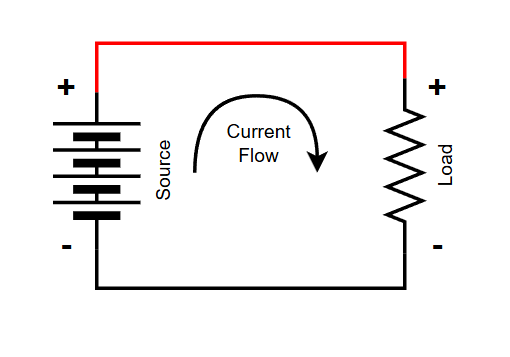
Figure 1: A basic circuit diagram. The source (left) pushes current through the red wire into the load (right) before it returns to the source’s negative terminal.
What if we wanted to add more loads to the circuit? Typically the way we do that is by plugging a load into an outlet or socket. But what exactly does that look like on a circuit diagram? Remember that every load has a positive and negative terminal. When we plug that device into a socket powered by a battery, we are really connecting the positive load terminal to the positive side of the battery, and the negative load terminal to the negative side of the battery. This is a parallel connection, and it looks like the following in a circuit diagram:
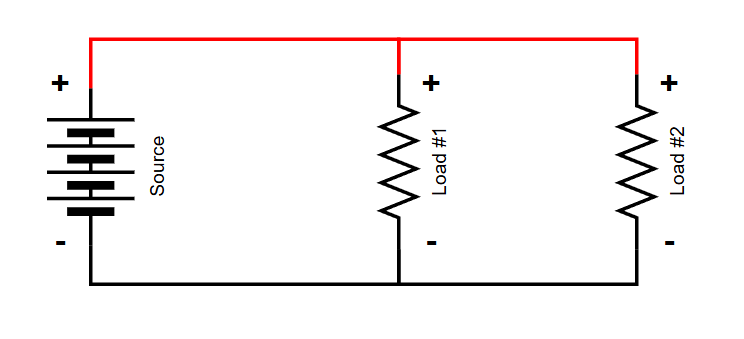
Figure 2: A parallel-connected load. Note that the red and black ‘wires’ are symbolic and not literal - they exist only to show these elements are connected, but not ‘where’ or ‘how’ they are connected.
With a parallel connection, all of the positives of every device are physically connected, and all of the negatives do likewise. The big benefit of this configuration is that we can connect and disconnect loads as we please without interrupting the others.
You might wonder what happens to the voltage and current provided by the source when this happens. Voltage for parallel connections is easy - it stays the same! If its connected to the red wire, it’s receiving the source’s voltage. So if each load was a socket and the source was a 12V battery, then each socket would have 12V on it. If we kept adding more sockets, the voltage would still be 12V. This is just like our house, where an outlet is an outlet regardless of how many other outlets are in use. There are real-world limitations to this, but for now we’re keeping it simple.
What changes is the amount of current the source has to provide. If we plug in more appliances to our RV, we know we’ll kill our batteries faster. We can use the same logic here. Let’s say each load draws 1A when connected on its own. If we plug in 3 loads to some sockets, then that’s 3A the battery must supply. If one of those three loads draws 2A normally, then the battery must supply 4A to the loads. The more loads we have in parallel, the higher the current will be coming out of the battery. So if you want to save some energy and camp for longer, unplug those extra devices! Your battery will thank you.
We can also expand the concept of parallel connections to more than just loads. Lets say we wanted to give ourselves more batteries to have extra energy for powering all our appliances for longer. If all of our loads require 12V, then we don’t want the battery voltage to change. We can use a parallel connection to give ourselves the extra energy we want without affecting voltage. It would look like this:
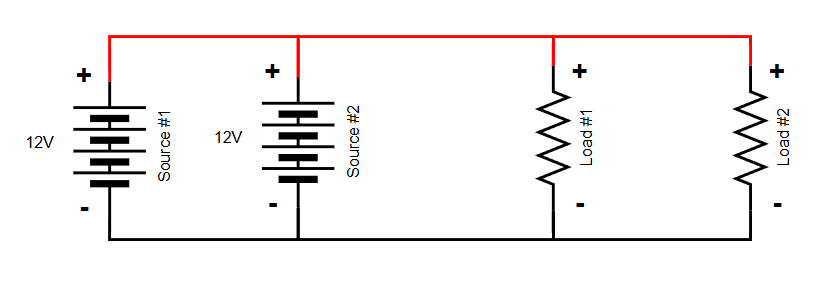
Figure 3: A parallel battery connection feeding two parallel loads.
Pretty simple, right? Just connect all the positives together, and do likewise with the negatives, and viola - we have parallel batteries just like with our loads. Now each of the batteries will split the total current consumed by the loads, allowing them to last longer overall.
We can even expand this concept to solar panels. Just connect positive to positive and negative to negative, and we have the same panel voltage with twice the overall current. We’ll talk more about the practicality of this later on, as it’s a little more complicated in the real world.
Fundamentals - Series Connections
What if we wanted to do something a bit different, like connecting two batteries in a row instead? What would this change? Well, let’s keep it simple and just have a single load attached. It would look like the following:
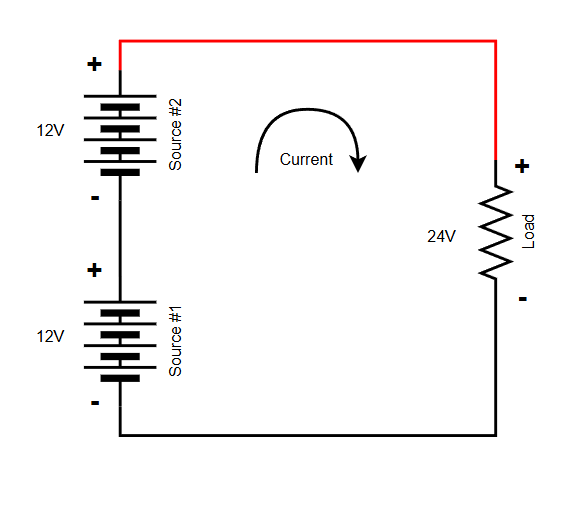
Figure 4: A series connection of two 12V batteries, creating 24V overall.
Now our batteries are making a series connection, where the positive of one battery is connected to the negative of the other, and the two remaining terminals are wired to our load. If we compare this to Figure 1, we can see the similarities. We only have a single closed loop through which current can flow. This means that the current which goes through the first battery will be the same current that flows through the second battery. It’s like water through a continuous pipe - never changing flow rate at any point in that pipe.
What does change is the voltage seen by the load. When we connect two or more batteries in series, the total voltage produced by them becomes the sum of their individual voltages. So in this simple case, the overall voltage of the circuit becomes 12V plus 12V, or 24V. Therefore, 24V is applied to our red wire and everything connected to it.
We can use this property to our advantage in certain situations. Let’s say we have 12V loads, but we’ve only got some 6V lead-acid batteries. Just add two of them in series, and boom! We have 12V to power our loads without issue.
We have to be careful with series connections, because unless the load is rated to handle the applied voltage, it will get damaged or catch fire! Some devices like lights and vent fans can only handle 12V. However, many loads like Starlink are able to handle a wide range of voltages, so this isn’t always a bad thing. Overall, careful planning is important when doing series connections!
All of this begs the question - could we connect two 12V loads in series to handle 24V? The answer in theory is yes, but this is never done in practice due to real-world complications. For one, you’d need identical loads such that the voltage would be evenly split across them. Additionally, a series connection requires both loads to be on at the same time. You couldn’t just have one turned on and the other turned off, because there wouldn’t be a closed loop for current to flow through! And lastly, since sockets connect loads in parallel, you would have to manually connect the positive of one load to the negative of the other. This is why series connected loads are neither practical nor safe in most situations.
Just how would you connect a 12V load to a 24V battery bank then? The answer is to use a buck converter rated to provide the right amount of power at the correct input and output voltages. This is a topic for another day, but it is the best option for those running 24V or even 48V systems with 12V loads. And as a bonus, they are not expensive!
Conclusion
That summarizes the basics! series connections are for increasing voltage, and parallel connections are for increasing current or capacity. If you’re ready to dive into the real-world application of these connections, check out part 2 of this ‘series’ of articles!