
Introduction to Mobile Wind Turbines - Part 1
Preface
This introductory article series covers the first 2-3 months of my experience with an Automaxx 400W wind turbine. This series is broken into multiple articles due to length of content covered.
Table of Contents
Part 1:
Introduction
Wind Fundamentals
Wind Turbine Basics
Part 2:
Wind Power and Energy
Wind Turbine Mounting and Mechanics
Field Data and Real-World Performance
Part 3:
Is Wind Power Right for You?
RV Wind Turbine Installation Starter Kit
Conclusion
Introduction
There is something primal about our connection with the wind. Wind is a force that cannot be contained, and which can completely destroy entire towns in a single night. Ancient cultures have attributed the wind to gods, deities, and spirits of significant strength. sailors and navigators have taken advantage of seasonal wind patterns to travel across continents for trade and commerce. Farmers used windmills to grind grains down into flour, feeding civilizations with precious bread. Ben Franklin used a kite to raise a key into the sky during a storm to learn more about lightning. Nations used flags in the wind to demonstrate their strength and independence. And in the last hundred or so years, we began to use wind turbines to directly transform the power of the wind into electricity. It is no doubt that wind power is the ultimate symbol of freedom throughout human history.
With the rising demand for alternative energies, wind turbines have seen increased use across the country. Utility companies have built large wind farms in open prairies, mountain ridgelines, and far offshore in the ocean. Small commercial facilities have begun experimenting with medium-sized wind turbines in parking lots and open fields. Off-grid homesteaders have started using micro wind turbines to supplement their batteries when solar power just doesn’t cut it. Even some sailors have mounted micro wind turbines to their sailboats to generate electricity far from land. And now the question arises - can RVers, van-lifers, overlanders, and nomads also make use of wind power for electrical resilience through the storms ahead?
Before we answer that question, we should step back and ask ourselves ‘why bother?’ With the rise of nomadic movements across the world has come the explosion of photovoltaic (PV, solar) technology for off-grid enthusiasts and rebels. While solar is an excellent resource to power our lives, it does not come without flaws. Increasingly-severe stormy conditions eventually result in depleted batteries as solar panels fail to produce enough energy. Even without stormy weather, tree cover, limited roof space, dust cover, and so many other factors limit solar performance in real-world situations. While some of these situations can be overcome with extra portable solar panels, bigger batteries, and strategic movement, there still comes a point where we have to ask ourselves an important question. Is adding more solar really a solution to a solar-based problem?
I think we’ve already answered that question with the use of portable generators, DC-DC alternator chargers, and occasional shore power hookups to recharge after a big storm. If we already accept that solar is not enough for all real-world situations, yet we seek to be fully independent, then why do we rely on another centralized resource like fossil fuels to be free? Most people don’t know that there is another option, and far fewer have tried the alternatives. But I’m here to tell you through my own experience - mobile wind turbines are the answer to 100% mobile electrical independence. But it’s not for everyone (yet) - micro wind turbine technology is still in an underdeveloped state. That doesn’t mean we should just wait around for the world to change though. Rather, the world needs innovators and problem-solvers to push wind turbine development into the future. So, I bought a micro wind turbine for myself. The goal? To shatter the myths and innovate with real tangible solutions to show that wind power is already good enough for many nomads and off-grid rebels.
Wind Power Fundamentals
Forget everything you know about solar power. Wind power is fundamentally different from solar power in many ways. If we go into this with presumptions, we’re only going to mislead ourselves. Instead, let’s start from scratch with the fundamentals.
Wind power is just another type of solar power
The wind doesn’t just magically blow across open fields. Something has to give the air energy for it to move. For wind, it’s motion is typically caused by a temperature difference. When the sun heats up air, it rises. Nearby cool air then moves to that low-pressure zone, creating wind. That then causes the air above it to fall, which makes yet another low pressure area for the hot air above to go.
While things get more complicated in 3D, this cycle is basically how wind works. It all starts with energy transferred from the sun to air particles via sunlight. The light heats the air, and this energy causes motion via wind. So when we use a wind turbine to produce electricity, we’re really collecting energy that originated from the sun, even if the sun isn’t shining!
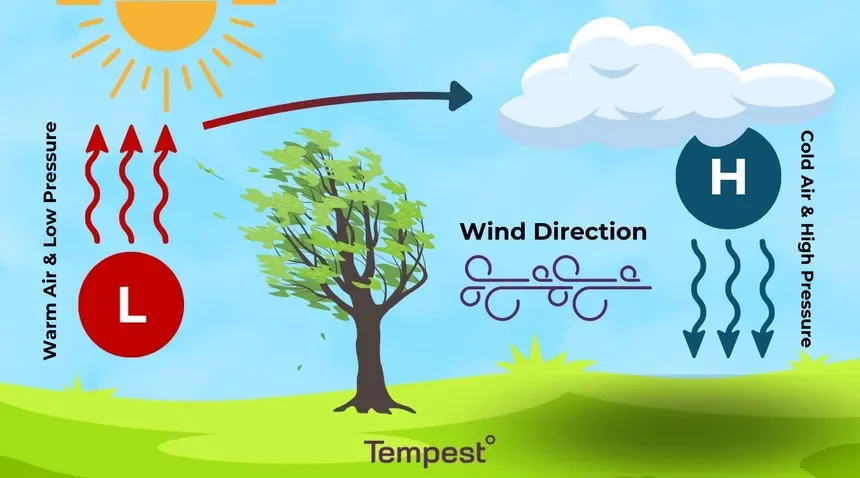
Figure 1: An illustration of the wind cycle and the sun’s effect on it.
It is not windy every day (and thank goodness!)
This might sound obvious, but you’d be surprised how many people forget this basic fact. It is not windy every day, so wind turbines alone cannot provide enough stable energy for our daily needs. If it were actually windy every single day with 15-20mph winds, we probably wouldn’t want to stay in that spot for our own comfort’s sake.
Instead, we should shift our mindset to enjoying the wind while it is blowing, knowing that it won’t always be that way. Wind turbines give us a way to harness unpleasant winds, turning a miserable day into an exciting feat of modern technology. I have found a renewed primal connection with the wind ever since I started this project, as I am more inclined to embrace windy days with a sense of joy and excitement instead of gloom.
Whether or not it is sunny is irrelevant
You may have heard people say that if its not sunny, its usually windy. Go ahead and ditch this myth - its just begging to skew your expectations. I’ve observed plenty of cloudy days where the wind was not moving an inch faster than on a sunny day. I’ve also observed many days where it was both sunny and windy. I’ve even seen many mornings, evenings, and nights where it was very windy only for that specific period of the day. The big benefit to wind power is that it is completely independent to how sunny it is. Otherwise, why would we bother harvesting the wind over the sunshine?
Wind duration can vary from a few minutes to several days
Winds come and go as they please. Sometimes its only windy for 30 minutes, and other times the wind blows for over 24 hours. I’ve had nights where the wind blew hard for 14 hours straight, repeatedly waking me up as it shook my whole rig. I’ve also seen winds that came in 5-minute bursts of 15mph winds, only to go dead still for another 15 minutes. That cycle of bursts repeated all day long without failure, just enough to stir up a ton of dust but not enough to be worth harvesting. Its very difficult to predict just how long the wind will blow for, and its often better to just let it do its thing.
Wind speeds also vary significantly, but hover around an average value
You never get just one wind speed. Wind is quite chaotic, fluctuating significantly in speed but generally hovering around some average value. The average wind speed might be only 10mph, but a gust of 40mph followed by several minutes of perfectly still air is more common than you’d think.
Most often, the average wind speed will gradually ramp up over an hour or so, float around that speed for a period, then finally slow back down to zero. That’s not to say random 30mph gusts don’t exist though. These random gusts are like rogue waves, destroying people’s awnings and sending loose tents flying. We have to keep these random gusts in mind when trying to harvest power from the wind.
Whether it is windy depends significantly on geography
I’ve observed valleys that were gusting with 25mph avg winds, but just a 30 minute drive away, my camp above a high canyon had significantly less wind - despite being very windy the day before. In general, winds are strongest in large open valleys, near shorelines or large bodies of water, and atop ridgelines of large mountains. But once again, the wind does as it pleases. Pretty much any terrain out west, whether it be a thick forest or a narrow canyon, will at some point experience strong winds that defy logic.
Sometimes geography can form funnels which wind travels through like a river. In California near Palm Springs, between the tall mountains surrounding I-10, wind flows downstream towards the Pacific Ocean through a narrow channel. Utility companies quickly filled this channel with wind turbines of various sizes because of the powerful and consistent winds that pass through. If you see utility turbines, you can bet that the geography is optimal for harnessing wind power.
Wind patterns are often seasonal
Global weather patterns can cause certain seasons like winter to be windier in certain regions. Spring and Fall can also cause windy conditions as the air warms or cools, causing pressure changes and strong winds. But if you find a windy location during one season (like Quartzsite in the winter), don’t assume it’ll be that windy all year long. The wind really, truly does as it pleases.
Wind is often turbulent and chaotic
Wind in the real world, especially closer to the surface, does not flow in a straight line. Laminar Flow describes wind that flows perfectly straight and uniform. This kind of wind is typically only found at very high altitudes or in artificial wind tunnels. Turbulent flow describes wind that does not flow perfectly straight. The more turbulent the wind, the more nonuniform it is - and the more difficult it becomes to extract power from it.
Think of turbulence like eddy currents found in a river. While most water in a river will flow downstream, an eddy current will circle back and flow a bit back upstream. Its the same thing with turbulence, you just can’t typically see it. Most of the air might be flowing in a specific direction, but some air can circle back or form chaotic, nonuniform patterns.
Its possible to visualize this with smoke. Some smoke will flow vertically upwards, while other smoke will form curls, spirals, and other nonlinear patterns. Just turn that image on its side and now you have a visualization of what wind turbulence looks like.
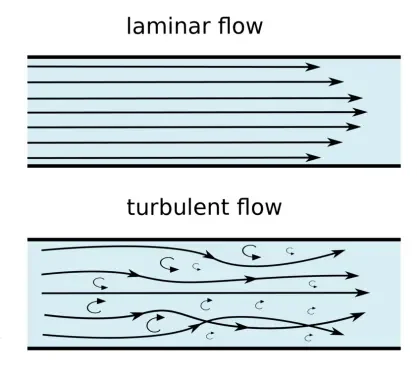
Figure 2: Laminar flow versus turbulent flow. While illustrated for water in a pipe, the same concept applies for wind flowing through the atmosphere.
All of this makes the point clear - wind power is fundamentally different from solar power. This is what we want, since we need something that creates meaningful electricity when the sun isn’t shining at full intensity.
Wind Turbine Basics
Now that we have a better grasp of how the wind works, we can start to talk about the turbines that harness that energy and turn it into electricity!
Windmills and Wind turbines are not the same thing
Let’s learn the correct terminology. A mill is a device that grinds grain into flour. A windmill is just a device that uses wind power to do this. A turbine, on the other hand, is a device that spins a generator to create electricity. A wind turbine uses wind power to spin this generator. So for our purposes, we’re talking about wind turbines, not windmills.
You may also hear the terms wind generator or wind charger. These are talking about different parts of the same thing. The turbine is the part that spins, the generator is the part that converts that rotation into electricity, and the charger is the part that makes the electricity safe for charging batteries. The charger is like a solar charge controller, but for wind power.
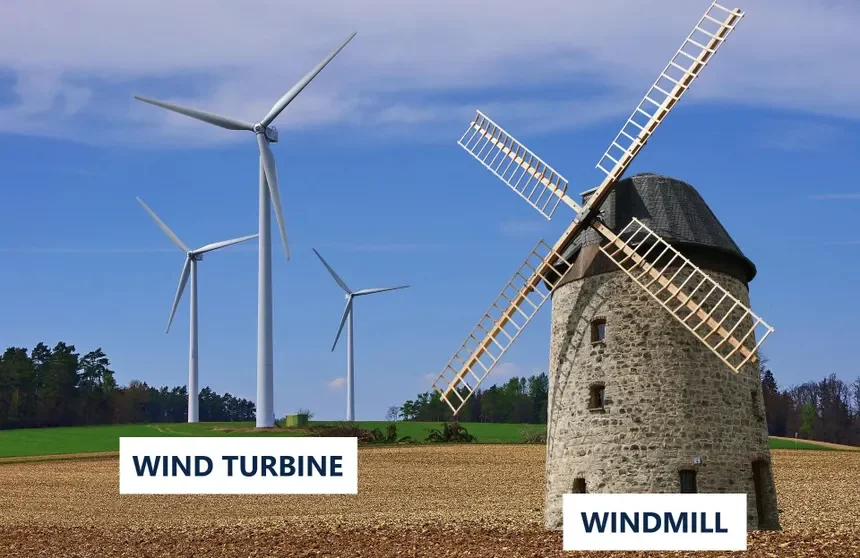
Figure 3: A visual illustration of the difference between a wind turbine and a windmill.
Micro wind turbine nomenclature - wind turbines have different parts that you may want to familiarize yourself with.
The most obvious part of a wind turbine is the blades. The blades are pushed by the wind and spin in circles due to their orientation. Then there is the tail, which is pushed by the wind to orient the turbine in the right direction. The head is the front part of the turbine, and the nose is the cap that goes on the head to make it more aerodynamic. The body, also sometimes called the nacelle, is the central structure that holds all the important stuff inside.
The blades connect to a shaft, which is just a rod which spins inside the turbine. The shaft connects the blades to the rotor, which is the part of the generator that rotates (think rotor = rotation). The other part of the generator is called the stator, which is the part from which electricity comes out (think stator = stationary = static). Out of this stator comes a set of 3 wires that hold the raw electricity produced by wind power. In my turbine, these wires go directly into a charge controller which converts the messy electricity into clean power ready to charge a battery. Regardless of whether the charge controller is inside the turbine or not, 3 wires will exit the wind turbine through its base. This base attaches to a flagpole or similar mounting tower. The 3 wires must pass through this tower and eventually plug into the rest of the electrical system to charge a battery.
Wind turbines are rotating machines, and that means we need a way to limit how fast they can spin. Many micro turbines have built-in brakes that activate automatically in excessively strong winds, or to prevent the turbine from overcharging your batteries. Mine also came with a manual brake switch which gives the option to turn the turbine on or off through these brakes, even in strong winds.
Some turbines may use furling to mechanically rotate the blades or the turbine and reduce surface area exposed to the wind. This slows the turbine in strong winds, preventing damage to the generator and electronics. Many larger turbines will also have a gear box which converts torque (rotational force) into speed. Large turbines with a gear box don’t have to spin so fast to create electricity because of these gear boxes. Micro turbines often do not implement a gear box, so the blades spin much faster. This makes for a great display even at low wind speeds, and is less likely to harm flying creatures! If larger turbines spun this fast, they would mechanically fail due to the size of the blades. There are Youtube videos of this occurring if you’re curious!
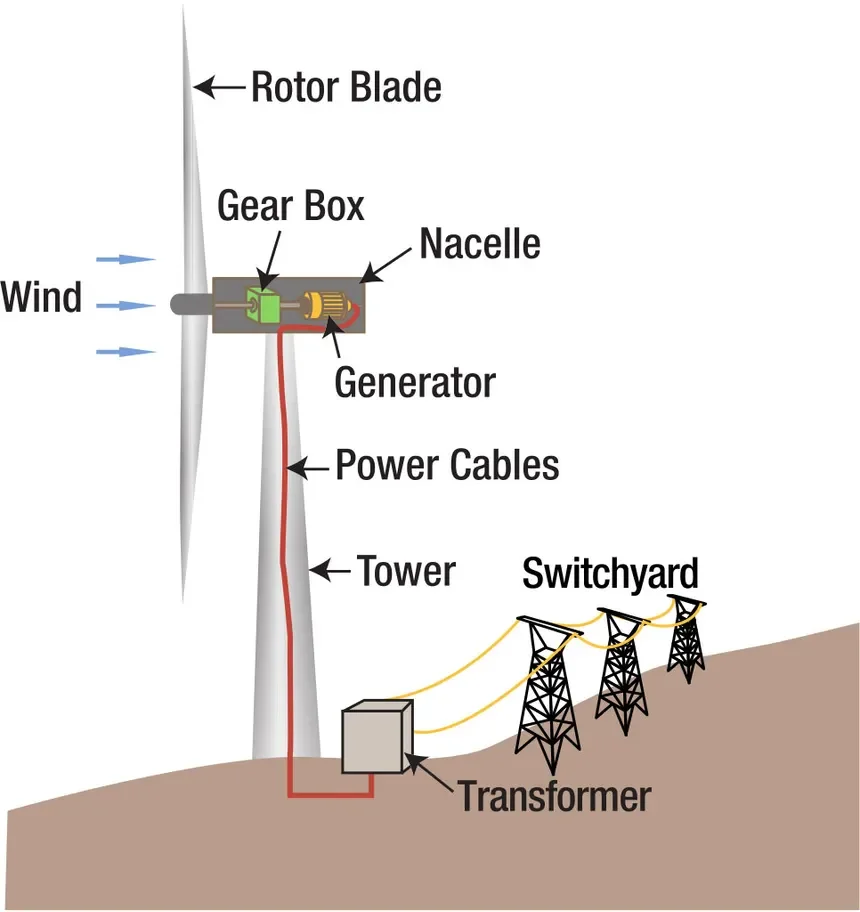
Figure 1: Anatomy of a utility-scale wind turbine. Note that utility-scale turbines do not have a tail. Instead, they rely on computerized motors to point towards the wind. Micro turbines, on the other hand, do not have a gear box and do not connect to a transformer. The tower of a micro turbine is typically a flagpole or similar metal pipe.
Wind turbine operating speeds
Wind turbine power output depend on wind speeds. But more importantly, they depend on consistent wind speeds. Just because a 30mph gust comes through doesn’t mean the turbine will immediately spin at that speed. It takes some time for the turbine to ramp up in speed, like a fast car trying to go 0 to 60mph.
Generally we can predict the average power output of a turbine from the average wind speed present, but there are many other factors like turbulence and proper mounting that will decrease the actual power output from the theoretical value.
Wind turbines don’t spin freely like a pinwheel. There are complicated physics involving the generation of electricity that restrict how fast they spin. Just because the turbine is spinning doesn’t mean its producing electricity, and just because its spinning at full speed doesn’t mean it’s going to output a lot of power.
Let’s talk about a few wind speed milestones at which meaningful changes in turbine performance occur.
Start-up Speed is the speed at which the turbine actually starts spinning. The wind turbine doesn’t generate any power at this state yet; it just spins freely in the air like a big pinwheel. It won’t spin fast because it has to overcome the inertia caused by the mass of the spinning parts. But it only takes about 2-3mph winds to get it to move enough to be a fancy lawn ornament.
Cut-in Speed is when we start seeing some power being generated. For our turbine and most micro turbines, this occurs around 6.7mph. At this speed, the turbine will appear to be spinning very rapidly, nearly at full speed even. However, the generator will only start to hum as it produces very small amounts of power. There are complicated physics involved that keep the turbine’s RPMs (Rotations per minute, or rotational speed) at about the same speed whether its producing 10W or 400W.
You can think of it like pushing a large rock. The rock’s speed will not change much regardless of how much force you put on it. But the amount of energy transferred from your body into the rock will change rapidly with increased force, even if you can’t see it with your eyes. In the same way, heavier winds won’t make the turbine visually spin faster. But they will transfer exponentially more energy versus lighter winds.
Rated Speed is the wind speed at which the turbine will produce its full power rating (in our case, 400W). For our turbine, this occurs around 30mph. Note that just because the wind speeds gust to 30mph, doesn’t mean the turbine will spin that fast. It requires prolonged, avg wind speeds of 30 mph in order to actually reach the maximum rated speed. For micro turbines, rated speed is the fastest it will spin before the automatic brakes kick in. This is to prevent thermal damage to the turbine’s generator and wiring.
Furling Speed is only applicable to turbines that can furl or rotate their blades or tail to spin slower in strong winds. After hitting rated speed, these turbines rotate to maintain the maximum power rating for a range of wind speeds. “Furling Speed” is the highest speed the turbine can maintain rated power at. Beyond this point, if the wind turbine does not stop spinning, it will mechanically fail.
Survival Speed is the top wind speed at which the turbine can be mounted and technically survive while the brakes are activated. Note that these are extremely high wind speeds above 100mph, at which point we should be more concerned about flagpoles breaking and tornadoes forming. It gives us peace of mind that we could technically leave the turbine mounted in heavy storm winds around 60mph, but its better to not push our luck if we don’t need to. Too many things can fail mechanically besides just the turbine at this point.
Clearly, wind turbines are fundamentally different from solar panels. And in some ways, they are more complicated - especially from an end-user POV. But that is no reason to fear them, as they have many clear advantages over all other electrical sources. These advantages will be gradually covered through the next parts of this article series.