
Solar 101 - Mobile Electricity for Beginners
Introduction
There is so much information out there about solar and off-grid power, especially for the mobile community. While 99% of it is nothing to be intimidated by, even a small electrical project can be daunting when you have no idea what all the terminology means. We’re here to clear the fog and shine a light on the path forward, so that any beginner - as long as they are willing to learn - can fully understand their electrical system. We’ll start with the basics, looking at simple electrical theory and terminology, and gradually build on each topic until you are armed with the knowledge to move into deeper articles.
We’ll focus on answering questions like, “What is an Amp-Hour?”, “Why do I need a solar charge controller?”, “How do I know what battery to buy?”, and much more. The goal isn’t to show you what we know - its to meet you where you’re at and empower you for electrical independence. So if you’re ready, let’s get started. And feel free to skip around the various topics here as you deem necessary. Everything is labeled to help you navigate this article as you see fit.
Electrical Terminology
Let’s start our journey by just talking about some common electrical terms, and simplified explanations to help you understand what they each mean.
Charge
Charge is the most fundamental electrical concept there is. Charge is basically the amount of electrical energy a particle of matter possesses. You may or may not have learned in high school Physics that a proton has a positive charge, an electron has a negative charge, and a neutron has no charge. Its the same thing here, except we only really deal with electrons - hence the name electricity.
Charge is measured in Coulombs (Q) - but you’ll likely never need to know this.
Electrons
Electrons are the negatively-charged particles which move through a wire. You might be familiar with electrons as the outer particles of an atom. And while this is true, they behave a bit differently with electricity. When you have a bunch of copper atoms bundled together, for example, some of the electrons are more free to move around without being permanently attached to one single copper atom. This is why we use copper, because it is a good conductor for flowing electrons, or electricity.
Voltage
Voltage, also referred to as electrical potential, is basically just the amount of force available to push electrons around. When you have a copper conductor just hanging around, the electrons might move a little bit on their own, but the movement is random and useless to us. But by applying a voltage to the copper, the electrons are forced to move in a coordinated direction. Electrons always flow from high to low voltage, just like water in a pipe flows from high pressure to low pressure. The difference in voltage across two points is called a voltage drop.
Voltage is measured in Volts (V).
Current
Current is a measure of the flow of electrons through a conductor. So while voltage pushes the electrons around, the amount of electrons actually flowing through a given section of wire is the current. Its important to note that current is not the ‘thing’ which is flowing. Current is the flow itself. You can also think of the water in a pipe analogy, where the water is the electron, and the amount of water which flows through a section of the pipe is the current.
Current is measured in Amperes, or just Amps (A). Oh, and to make it more confusing, They decided to represent current with the letter “I”.
Resistance
Resistance is like friction in a pipe. It slows the water down a bit, but it doesn’t completely stop it from flowing. Its the same thing with electricity - higher resistance reduces the flow of electrons in a wire, but it doesn’t outright stop it.
Resistance is measured in Ohms (Ω - from the Greek letter Omega).
Circuit
When you combine voltage, current, and resistance together, you get a circuit. A circuit is basically a closed loop with a voltage source, a resistive element (also called a load), and conductive wire which allows electrical current to flow. The voltage source pushes the electrons, the moving electrons are the current, and the resistive load makes use of the current while also keeping it from moving too fast. The mathematical relationship between these 3 elements is called Ohm’s Law, which is, V=I*R. Again, V is voltage, I is current (because why not?), and R is resistance.
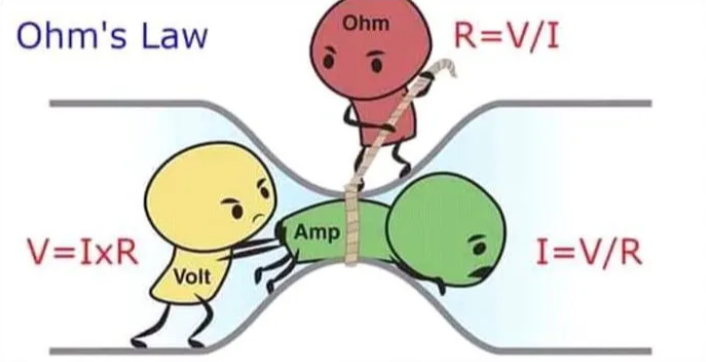
Figure 1: Ohm’s Law useful meme
Power
When current flows through a resistive load, that load is said to receive power. Power is mathematically the product of voltage and current, or P=V*I. Power is like current in that it measures the instantaneous electricity through a point. While electricity is not the same as thermal heat, electricity does transform into heat as it passes through a resistive load. This heat is also power, just in a different form. So when we calculate P=V*I through a resistor, we are literally calculating the amount of heat that is produced when electricity flows through it.
Power is measured in Wattage or Watts (W).
Energy
Energy is to power like charge is to current. Remember how electrons are the particle that actually moves, while current is the rate at which those electrons flow? Same deal here. Energy is the actual thing that flows, while power is the flow (or transfer) of energy. You might know from physics that energy is always conserved, never destroyed. This is true even for electricity. In order for electrical energy to exist, it must be transformed from some other type of energy first. This process is called electrical generation.
Energy is measured in Watt-hours or Joules (Wh or J). These are basically the same thing, but we will use Watt-hours the most.
Electrical Source
An electrical source is the device which provides electrical energy to a circuit. Most electrical sources are voltage sources, or devices which deliver a constant voltage, but whose current depends on the load (through Ohm’s Law, V=IR). On the other hand, current sources provide a constant current, but their voltage depends on the load. Solar Panels are actually a current source, because they output nearly constant current regardless of sunlight intensity. On the other hand, generators like a diesel or LP generator behave as voltage sources, because they provide constant voltage but variable current, depending on the load.
Efficiency
In an ideal electrical circuit, all of the energy that is generated by the source is electrically transferred to the load. However, this never actually happens in real life due to small resistances in wires and components, which dissipate some energy as heat. Efficiency is the measure of how much energy is transferred from the source to the load. We want this number as close to 100% as possible, but depending on the component, efficiencies are usually around 90% to 98%.
Efficiency is denoted as the Greek letter ‘Eta’, or η. It basically looks like the letter ‘n’, but with a longer leg. For simplicity, you’ll usually just see efficiency abbreviated as ‘eff.’
The equation for calculating efficiency is: eff=Pout/Pin, where Pin is the input or source power, Pout is the output or load power, and the difference is the system’s efficiency.
Direct Current (DC)
Direct Current is the simplest and easiest kind of electricity to explain. In Direct Current systems, power can only flow one way, and almost everything is constant over time. This means that, in two random moments in time, the voltage and current of the system will be essentially the same. This makes the math really easy, and the most you’ll ever have to do is multiply numbers together.
Alternating Current (AC)
Alternating Current is a completely different beast, and is honestly a whole lesson in and of itself. In AC systems (not to be confused with A/C or Air Conditioning), current is constantly changing directions, and voltage is sinusoidal. Your residential home power outlets provide AC power to your appliances. You’ll often hear the voltage referred to as 120VAC or 120Vrms. VAC just stands for Alternating-Current Voltage, and rms stands for Root-Mean-Square. The important thing to know is, 120V is a mathematical average of the constantly-changing voltage, so while 120V might be a constant value, it represents a voltage which is not actually constant. We’ll talk more about this in other articles.
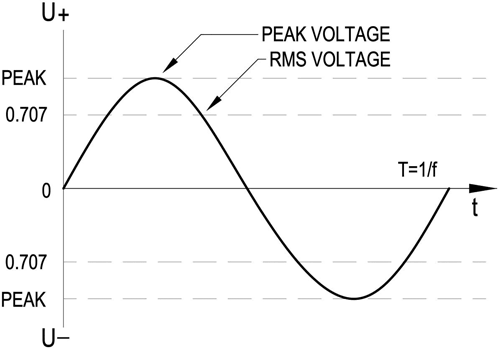
Figure 2: One cycle of a sinusoidal voltage waveform
Irradiance
Irradiance is a bit of an advanced term, but its good to be generally familiar with it for solar systems. Irradiance is a measure of the amount of power available through sunlight, over a given area. Solar panels focus on covering as much surface area as possible, because they’re trying to absorb the irradiance available from sunlight.
Irradiance is measured in Watts per Square Meter (W/m^2).
Photovoltaic
The Photovoltaic Effect is a physical phenomenon which solar panels take advantage of, in which sunlight is directly transformed into electrical energy upon contact with a specific type of material. Solar Panels are semiconductors, meaning they only conduct electricity under specific scenarios. The specific semiconductor material in Solar Panels was made to allow electricity to flow when in direct contact with sunlight - hence the term Photovoltaic Generation.
Photovoltaic is often abbreviated as “PV”.
Battery
A battery is any component which stores energy. In fact, batteries don’t even have to be electrical at all. But of course, we want to focus on electrical batteries, which also happen to be chemical batteries. Early on in the days of electricity, it was discovered that some chemical reactions could generate electricity. It was also discovered that some of these reactions were reversible, allowing rechargeable batteries to effectively store electrical energy and release it through a chemical reaction on demand. This has become a critical part of solar systems, as it allows excess energy from the panels to be stored during the day, and released at night when the solar panels aren’t operating.
Current Capacity
While this isn’t an official electrical term, I think you might come to appreciate this distinction in a moment. Batteries are often rated in Voltage (V) and “Capacity”, given as Amp-Hours (Ah). However, the term ‘Capacity’ is misleading on its own. As we discussed before, Watt-hours are a measure of energy, and are better at describing a battery’s energy capacity. Amp-Hours, on the other hand, don’t explicitly refer to how much energy a battery can hold. Instead, Amp-Hours are a way of describing how much current a battery can absorb or send out. For this reason, I refer to Amp-Hours as a measure of Current Capacity, not just ‘capacity’.
Series
A Series connection is a type of connection made between two or more solar panels, batteries, or similar components. Series connections are used to increase voltage, but to keep current capacity constant. If a single component in a series connection breaks or fails, all of the components in that series will fail.
Parallel
A Parallel connection is another type of connection made between two or more solar panels, batteries, or similar components. Parallel connections are used to increase current capacity, but to keep voltage constant. If a single component in a parallel connection breaks or fails, the other components will continue to function.
Charge Controller
A charge controller is a power electronics device which controls the flow of energy into a battery. Batteries can only be safely charged in a particular way, and this varies depending on the specific battery. A proper charge controller will be programmed to match this safe charging pattern, allowing various sources to charge a battery without causing damage. A solar charge controller is designed to convert solar power into battery power. A DC-DC charge controller is designed to convert a vehicle’s alternator power into battery power. Likewise, an AC-DC charge controller converts residential 120VAC power into battery power.
PWM Charge controller
A PWM charge controller is a type of solar charge controller. PWM controllers use older technology to convert solar power to battery power, and are generally less efficient at 90% power conversion.
MPPT Charge controller
An MPPT (Maximum Power Point Tracker) charge controller is a more modern type of solar charge controller. MPPT controllers use specific software algorithms to maximize the conversion of solar power to battery power. They can reach 95-98% efficiency, which is considerably better in comparison to a PWM controller.
Inverter
An inverter is a device which converts power from DC to AC. Through internal electronic switches, an inverter is able to take a constant DC voltage and create a sinusoidal AC voltage similar to what you’d get from a residential power outlet. A Pure Sine Wave inverter will produce a smooth sinusoidal waveform which works for all appliances. A Modified Sine Wave inverter is cheaper, but produces a more jagged waveform that can actually damage sensitive electronics.
Rectifier
A rectifier, usually referred to as an AC-DC charger or just a charger, is a device which converts AC power to DC. It basically does the opposite of an inverter, and is useful for charging batteries through shore power. Some inverters are bidirectional, meaning they can operate either as an inverter or a rectifier. These components often cost thousands of dollars, and are also referred to as inverter/chargers.
Converter
A converter is a device which converts DC power from one voltage to another. Converters can either increase (boost) or decrease (buck) voltage, and some can even do both (buck-boost). This is a nuanced process that involves rapid electronic switches, microcontrollers, and manipulation of electromagnetic energy in capacitors & inductors. But all you really need to know is that they can convert 12VDC to 24VDC, and vice versa.
Transformer
A transformer is a device which converts AC power from one voltage to another. Unlike with DC power, it is actually very simple to convert AC voltages from one to another. Through Faraday’s Law and Lenz’s Law, magnetic energy can be used to transform the AC voltage through two coils of wire. Transformers are also used inside of some inverters to provide isolation, but this is an advanced topic that you likely will never need to understand. All you really need to know is that they can convert 120VAC to 240VAC, and vice versa
Short Circuit/Fault
A Short Circuit is an event where current is able to flow freely through a source while bypassing the intended load. Because of Ohm’s Law, a low resistance path across a voltage source will result in hundreds or even thousands of amps flowing through a wire. This will generate heat rapidly, causing the wire insulation to melt and resulting in further shock and fire hazards if not stopped immediately.
In DC systems, a Fault and a short circuit are the same thing. However, in AC systems, this is not always true. For our understanding in DC systems, we will use these terms interchangeably.
Fuse
A fuse is a protective element which is designed to fail before any component or wiring gets damaged by a fault. There are many types of fuses on the market, but their ultimate purpose is the same - stop the fault before it causes a fire or other permanent damage.
Circuit Breaker
A circuit breaker is a protective element which, like a fuse, is designed to fail before any component or wiring gets damaged by a fault. The difference is, circuit breakers are reusable and can operate under load. This is great for disconnecting components for maintenance, or just to shut off power without waiting for a fuse to blow. It is important to note that circuit breakers are rated for either DC or AC systems, and the two are not interchangeable.
Fuse Block
A fuse block is a component used for distributing power to multiple low-voltage DC circuits. Fuse blocks themselves are usually rated at 50-100A, and the circuits fed from these blocks are usually rated at 30-50A maximum. Fuse blocks distribute power through blade fuses.
Panelboard
A panelboard, sometimes referred to as a panel, is a component used for distributing power to multiple AC circuits. Panels are typically only found in permanent structures or in large RVs with multiple AC power circuits. Panels distribute power through AC circuit breakers, or in some cases, fuses.
Bus Bar
A bus is a section of an electrical circuit that holds a specific voltage. Buses are sometimes also referred to as nodes. A bus bar is a solid piece of conductor with bolts for making multiple connections to the same point in a circuit. These are ideal for connecting multiple components together, such as paralleling multiple batteries, or connecting a battery to an inverter, fuse block, and any battery chargers.