
Why Your RV Can’t Sell Power to the Grid
Introduction
Let’s say you have a large RV solar system, and your batteries are always fully charged. A common question that arises is, “Can I sell my extra solar power back to the electrical grid?” The answer isn’t what most RV owners want to hear, but the truth is that it just isn’t feasible. In this article, we’ll explore the engineering behind why such connections are unrealistic and even potentially dangerous, and the alternatives for building more resilient communities and electrical infrastructure.
AC vs DC Power
When it comes to PV (Photovoltaic, AKA solar) systems, they generate DC (Direct Current) power. This means the generated voltage is constant, and power can only flow one way. The power grid, on the other hand, generates AC (Alternating Current) power. This means that power is actually constantly changing direction, as the voltage fluctuates from positive to negative. Since most appliances run off of AC power, its important that we understand how inverters bridge the gap for solar PV systems.
In a residential system, we’re mostly dealing with 120VAC or 240VAC circuits. 120V is an RMS (Root-Mean-Square) voltage, meaning it is a type of ‘mathematical average’ of the actual peak voltage available through your outlets. So while your multimeter might read around 120V when testing your outlets, the voltage is actually always changing - even 60 times a second (60 Hz, or Hertz). The interesting thing is, 120V isn’t even the maximum voltage available at your outlet. Because 120Vrms is an average, it is actually a factor of √2/2, or 0.707, of the true maximum or “peak” voltage possible. This means that for a 120V outlet, the voltage actually reaches almost 170V each cycle! And because the voltage cycles from positive to negative, the voltage difference between the two peaks can be up to 340V in a single cycle - and that happens 60 times a second!
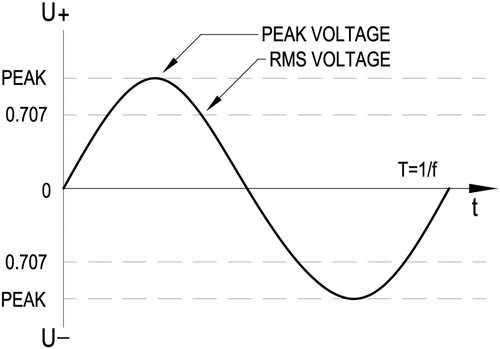
Figure 1: Typical Sinusoidal Voltage Waveform, with peak voltage ‘U’, frequency ‘f’, and period ‘T’.
Inverter Limitations
So what does all this complicated math have to do with selling power back to the grid? The answer lies in your inverter. An inverter is basically the bridge that connects DC voltages to AC voltages. Without it, the DC power generated by solar power wouldn’t be useful to the electrical grid or even your toaster. An inverter is a device that transforms DC power to AC through manipulation of electromagnetic fields and super fast switching of electronic transistors. Because of this component’s special ability to make solar power more useful, inverters are commonly found with nearly all solar power systems.
But there’s a catch - what happens if an inverter’s output AC voltage is not synchronized with the AC voltage of the power grid? Think of it like this - the electrical grid in a single instant might be sitting at positive 170V - the positive peak voltage of a given cycle. But if an inverter isn’t in sync with it, then the voltage of the inverter could be anywhere else in the cycle, or even negative 170V. At that moment in time, there is a 340V difference between the solar inverter and the grid - and if connected, things could go south real quick. Because of Ohm’s Law (V=IR), this voltage is proportional to the current. Because there is very small resistance between the inverter and grid when connected, the current could shoot up astronomically high to thousands of amps. This would instantly fry your inverter, start a fire, and possibly much worse.
So how does connecting an inverter to the grid actually work? After all, with all the homes now putting solar on their roofs, someone must have figured out the trick. And it is true - thanks to power electronics, there are inverters on the market that can synchronize with the grid to safely sell energy. These are called anti-islanding inverters, and they are commonly used in residential PV systems as well as commercial microgrids. But due to price and complexity, not all inverters are capable of this feature. In fact, most if not all RV inverters are specifically designated as Off-Grid inverters - meaning they do not have anti-islanding capabilities. So unless your inverter explicitly says it is capable of connecting directly to the electrical grid with anti-islanding capabilities, it is extremely unsafe to plug it directly into the power grid.
Power Grid Limitations
Now, let’s say you did have an anti-islanding inverter built into your RV. There are a couple of reasons why it is still unfeasible and even dangerous to connect it to the electrical grid. For one, typical residential electrical meters do not come with bidirectional capabilities. Meters are what tell the electrical grid how much to charge you, or in the case of PV generation, how much to pay you. If your solar power is not metered when being fed back into the grid, the power company isn’t going to pay you. In fact, for this next reason, they’ll probably sue you!
That second reason is PV interconnection permitting. Every solar system connected to the grid must be inspected and authorized by the utility companies before connection. The primary reason is safety - even if your inverter is synced with the grid, it can actually cause another dangerous situation known as overvoltage. In a typical unidirectional grid setup, as was common before PV systems became popular, power flowed from the utility to the customer. As power flowed through transmission lines, the voltage would drop due to inefficiencies in the copper and aluminum conductors. So, utilities needed to use autotransformers, capacitor banks, and other fancy voltage regulation techniques to make sure each customer was getting the proper voltage at their electrical outlets and panels. The problem with residential photovoltaics is it provides voltage compensation at the load itself.
Imagine a situation where a customer who didn’t have solar installed yet was very close to a voltage regulator. This means their home is already sitting at the higher end of the safe 120V operating range. If they were to add solar to their home, this would actually push the grid voltage up, even beyond the range the regulators can moderate. This creates an unsafe overvoltage condition on the grid, creating all kinds of issues from power surges to damaged equipment or worse. To avoid this, the utility company runs a computer simulation to see what would happen if a set of customers added a certain amount of solar power to their home. This helps predict and resolve overvoltage issues before the connection is made, giving the utility time to make necessary changes before authorizing the use of solar on a home.
Now imagine such a setting where the solar-powered ‘home’ is actually an RV. Now, the customer can choose to connect and disconnect at will, leading to significant voltage instability on the grid. Because this is so much more difficult to manage, utility companies generally don’t even allow mobile PV systems to connect to the grid. So even if the RV has the right inverter, a PV-permitted home, and a bidirectional meter, the fact that their generation is unstable from the grid’s point of view makes it unfeasible to allow RVs to sell excess solar energy back to the grid.

Permanent Residential Solar Power
Because it is permanently connected to the home, the electrical sees a predictable source of power that can be safely regulated.
What You Can Do Instead
If RVs can’t connect to the power grid, then that raises a few questions. For one, is it actually still a good idea to oversize a solar power system? The answer is, likely not! When you oversize a PV system, you spend hundreds or even thousands up front for energy that is never used. Your batteries will stay fully charged, but beyond that is just wasted roof space, weight, and even fuel mileage. The better idea is to have a system designed specifically for your calculated energy needs - which of course, is where we at Solar Ark can help!
But let’s say you do have extra solar power, and you don’t want to just remove the extra panels. What are some other options? Luckily, we live in an evolving world where creative solutions are becoming mainstream. The key is this - you don’t need an outdated electrical grid full of infrastructure from the 1970’s to sell power to a local community. Modernized microgrids and alternative energy grids are showing that there are better ways to make use of extra energy to build community and resilience. Some RV parks are beginning to offer ‘shared solar’, allowing multiple RVs to interconnect to each other without a grid connection. This enables larger RVs to ‘sell off’ extra solar power to weaker systems with energy deficiencies, balancing the equation. While its typically more difficult to calculate the exact cost difference, these parks sometimes offer incentives like cheaper campsites to encourage the sharing of extra power.
Additionally, some permanent off-grid communities are building their own electrical grids. By hardwiring their solar, wind, and hydropower systems to each other’s homes, they can guarantee greater resilience in the case of power loss in inclement weather or similar disasters. Thanks to anti-islanding inverters, this is a reality that is quickly growing in permanent off-grid alternative communities.
While selling power back to the grid via RVs would be a neat idea, the feasibility just isn’t there given the grid’s ancient (and failing) infrastructure. But this doesn’t have to be a loss. Through our continued resilience, education, and community, we can re-engineer the future of electricity to be more sustainable, modular, and liberating.